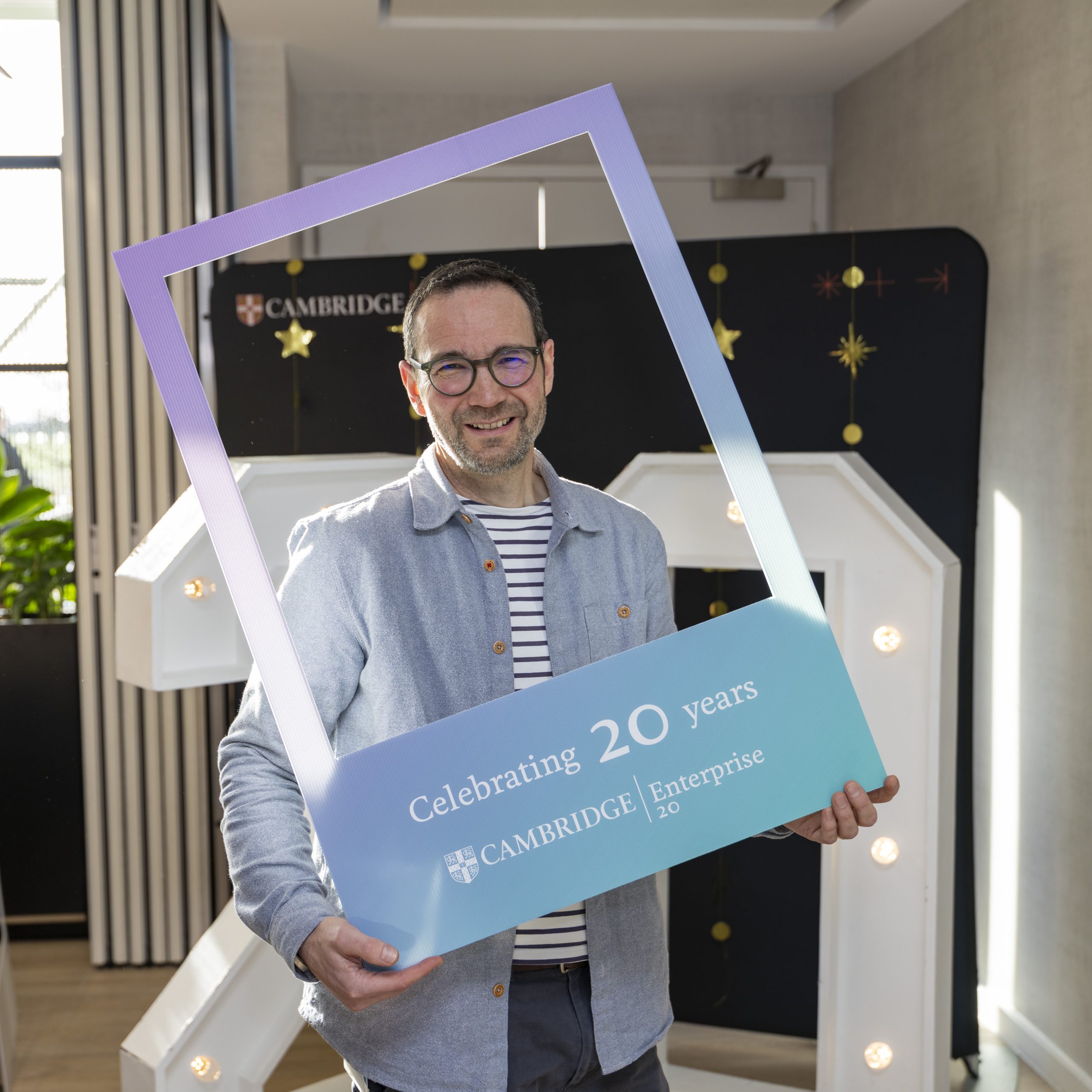
Boris: On being one of the longest serving members at Cambridge Enterprise
20th anniversary storyCambridge Enterprise will turn twenty at the end of the year – specifically the 1st of December. To celebrate two decades of continued impact and innovation, we spoke with eight members of staff representing different areas of the organisation – from business development, to investment management, event organisation or senior leadership.
Our aim: How Cambridge Enterprise, throughout the years, has helped them evolve and grow in their careers and also learn about their views of its impact on innovation in Cambridge and beyond.
In this fourth piece of our people spotlight, we spoke to Boris Bouqueniaux, Head of Business Support. Boris has been part of Cambridge Enterprise since its inception in 2006, having joined in 2003, in what was still the Technology Translation Office of the University of Cambridge. Not only is he one of the company’s longest serving members but has also been pivotal in changing how data underpins process at the company.
We asked him to describe the culture at Cambridge Enterprise.
“There’s an openness to new ideas and a willingness to innovate and empower people that makes Cambridge Enterprise a great place to work. It’s a place that combines professionalism with empathy, creating an environment where ideas are welcomed and people are trusted to make a difference.
“I’ve always felt it’s a culture that values innovation and wellbeing, and importantly, recognises people as individuals.”
How has the company enabled you to grow in your career?
“I have been able to progress through different roles across different teams and expand my responsibilities as the organisation evolved. This has allowed me to feel part and to contribute to the company’s success, all while balancing family life.
“Although I’ve been here for more than 20 years, the company has grown from about 17 employees back in 2003 to over 120 today, and both Cambridge Enterprise and my successive roles have evolved so much that it has never felt static.”
“There's an openness to new ideas and a willingness to innovate and empower people that makes Cambridge Enterprise a great place to work.”

He shared some anecdotes from the early days.
“When I joined, we were all in the corner of a big open plan office and there was about fifteen to seventeen people. I was hired in the most junior role at the time, which was case administrator. However, because there were very few of us, I ended up also doing lots of different things, from writing cheques distributing commercialisation income to academics, to preparing marketing packs for visitors.
“Being such a small department at the time, there was a close-knit feel to it all. After a team meeting, the whole department would go down to the Cambridge Market Square and have lunch together.”
He has helped shift roles from task to project.
“When I joined, each support role was determined by task. This meant that work could feel rather repetitive, and we saw quite a bit of turnover. Because I’d been doing these roles, I understood the feeling, so I thought, instead of having one person just doing patents and licences and another simply dealing with new disclosures, why don’t we have one person doing it all for the life sciences team and another for the physical sciences team.
“In this way, they would be involved along the life cycle of the project, supporting commercialisation colleagues from start to finish, becoming an intrinsic part of the team and organisation. I do think this helped improve how we operate at Cambridge Enterprise, focusing on projects and portfolios instead of tasks.”
His team are the data wizards at Cambridge Enterprise.
“It is very important for us to keep up with all the data we manage – projects in our portfolio, active patents and licences, how much translational funding we support individual researchers apply for, how many University spinouts are formed and how much investment has gone in, just to name a few examples.
“This is critical for us and the University to demonstrate impact – what are the outputs of the research funding the University receives, the disclosures, consultancies and licences. How are our spinouts and start-ups faring… it’s down to the data. Robust data builds trust, a trust that is essential for us to continue doing our work.”
We ask him to do some time travelling, and tell us what he thinks Cambridge Enterprise will be like in 20 years’ time.
“I hope that what makes the culture quite unique remains. There is something special, a feeling of being appreciated, of being part of a community, working together to support the University researchers make a greater impact.
“I also hope we won’t become complacent and that we continue to innovate. To seek improvement in how we work, navigate ways to become more efficient. We are part of a prestigious ecosystem, but that should not be seen as a given and we must give our best to uphold our mission and continue making an impact.”
We asked Boris to finish these sentences:
- The impact of Cambridge Enterprise’s support on University research is… “diversifying and growing rapidly.”
- At 20, Cambridge Enterprise is… “still a place achieving great things with a family feel.”
- We knew we’d made a difference when we… “reshaped the way we supported our colleagues in the Technology Development and Licensing team so they could focus on the ideas and technologies University researchers are trusting us with to protect, develop and commercialise.”
- Behind the scenes, we… “are rigorous with our processes and methodical when collecting data, and we try to have fun whilst doing it!”
Reflecting on our people and our progress
Boris’ reflections highlight just how much Cambridge Enterprise has changed since its foundation in 2006.
His insights form part of a wider set of anniversary pieces that highlight different voices from across the organisation. Each one will share personal perspectives on how Cambridge Enterprise has evolved and what continues to drive our mission. Together, they will show how we are still learning, still growing and still committed to supporting innovation from the University of Cambridge.