Advancing photon-counting CT imaging
SpinoutsCambridge spinout Clarity Sensors, will lead PICASO, a three-year collaboration with the Science and Technology Facilities Council (STFC) to develop and validate a perovskite-based photon-counting multispectral detector module for medical CT (computed tomography) imaging.
Clarity Sensors Limited, has been awarded a £1.9 million Product Development Award by the National Institute for Health and Care Research (NIHR) through its Invention for Innovation (i4i) programme.
Clarity Sensors is the lead organisation and will receive £1.3 million, with the remainder funding the work of STFC’s Technology Department. The project began on 1 October 2026 and will run for 36 months.
Colour photon-counting CT measures individual X-ray photon energies to reconstruct high-resolution images that precisely differentiate tissues and materials. In clinical use, it has been shown to produce higher-resolution images at substantially lower radiation dose than conventional CT, and every major CT manufacturer is now developing photon-counting systems. Wider adoption is limited by the sensor materials used today, cadmium telluride and cadmium zinc telluride. These take months to grow at temperatures above 750 °C, and only a small number of suppliers worldwide can produce them at medical grade. Because systems are premium priced, photon-counting CT is currently available only in specialist centres such as teaching hospitals and is not yet widely available across the NHS.
Clarity Sensors is developing a second generation of photon-counting sensor based on halide perovskite single crystals, which are grown at around 40 °C in a matter of days. In laboratory testing, the company’s sensors have already performed comparably with the cadmium telluride sensors used in current commercial systems on key detector measures, with further optimisation improvements to come, and have operated stably under X-ray flux and bias conditions relevant to CT.
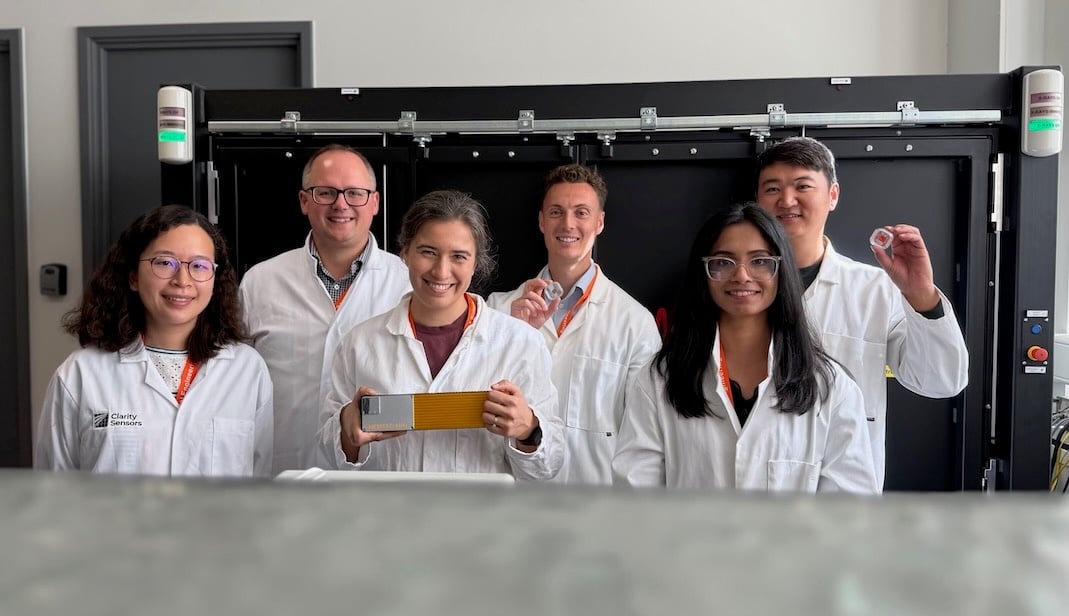
The Clarity sensors team in the lab holding the Picaso crystals. Credit: Clarity sensors
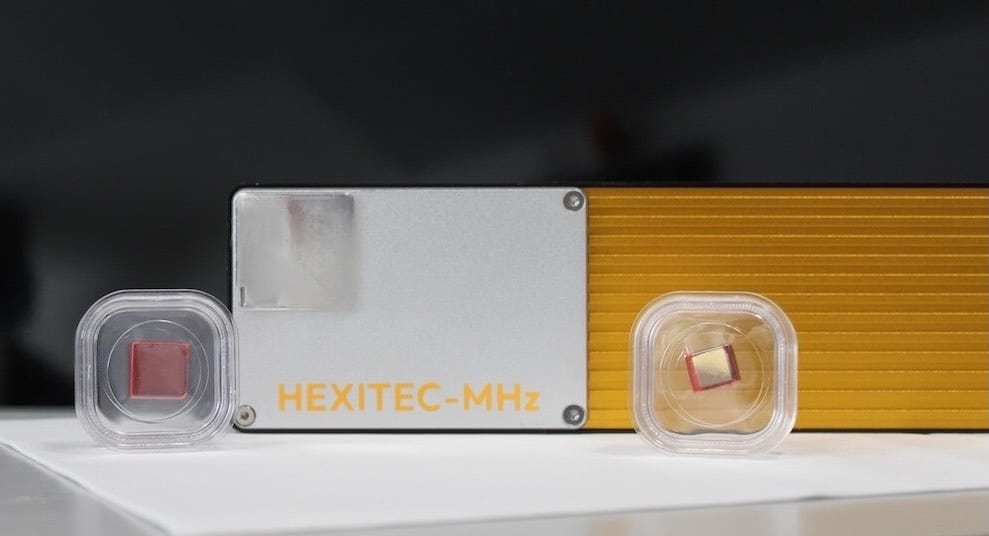
PICASO will combine Clarity Sensors’ perovskite sensors with readout electronics developed by the STFC’s Technology Department. HEXITECMHz is the latest generation of STFC’s UK-designed High Energy X-ray Imaging Technology which operates at a continuous frame rate of one million frames per second, delivering unparalleled energy-resolved information at CT-relevant fluxes. The partners will optimise the HEXITECMHz readout chip for perovskite sensors, then build and validate a complete photon-counting detector module in a CT-relevant preclinical environment, advancing the technology from Technology Readiness Level 3 to 6. During the project, Clarity Sensors will also establish pilot-scale sensor production at its Cambridge facility, implement relevant ISO 13485 quality management system controls.
Dr Hayden Salway, CEO of Clarity Sensors and Lead Applicant, said:
“Photon-counting CT offers real benefits for patients, but the materials it depends on today are slow and costly to make. We grow our perovskite sensors in a matter of days at low temperature, and our initial laboratory results show they can already perform comparably with the materials in current systems.
"This NIHR award, and our collaboration with STFC's detector specialists, will allow us to turn these results into a complete detector module and test it under the conditions a CT scanner demands. It is a significant step towards our goal of supplying perovskite semiconductor detector technology to CT manufacturers"

Dr Matthew Veale, Group Leader of the STFC’s Technology Department’s Detector Development Group, said:
“For 20 years, our HEXITEC® technology has advanced the field of colour X-ray imaging, bringing capabilities once confined to national science facilities into laboratories and industry. The combination of our next-generation HEXITECMHz detector technology with Clarity Sensors’ innovative perovskite semiconductor materials represents an exciting opportunity to widen access to affordable colour CT imaging.
“With NIHR funding, working with Clarity Sensors, we aim to advance knowledge of these emerging materials, improve lives through the development of more accessible medical imaging technologies, and drive growth by strengthening UK sovereign capability in advanced X-ray detector technologies.”
Clarity Sensors spun out of the Optoelectronic Materials and Device Spectroscopy Group at the University of Cambridge in 2022, after the idea formed during the pandemic. The work follows Professor Sam Stranks’ research into halide perovskites, semiconductors with emerging applications in photovoltaics, LEDs, and X-ray detectors. The high sensitivity of these materials makes them well suited to improving X-ray imaging resolution as well as lowering the associated radiation doses.
Cambridge Enterprise have supported Clarity Sensors with a Technology Investment Fund of £210K in 2024, to generate critical detector validation data and help find derisking strategies for the perovskite photon-counting detector developed in Sam Stranks lab.